

29 June 2026
Recovered Carbon Watch: How CarbonCraft and Bangalore Watch Company Turned Waste into Design
What if waste wasn't the end of a material's story?
Most industrial byproducts follow a familiar path. They are landfilled, incinerated, or left to accumulate in waste streams. Once their primary purpose is served, they are rarely seen as resources with future value.
But materials do not lose their potential simply because their first lifecycle has ended.
The challenge is finding better ways to recover them. More importantly, finding meaningful ways to use them again.
At CarbonCraft, this belief has shaped how we approach material innovation. Instead of asking what products should be made, we first ask what existing waste streams can become. Our latest collaboration with Bangalore Watch Company explores that idea in an entirely new way, taking a material more commonly associated with industry and transforming it into one of the most visible components of a precision mechanical watch.
It is not just a different application.
It is a different way of thinking about waste.
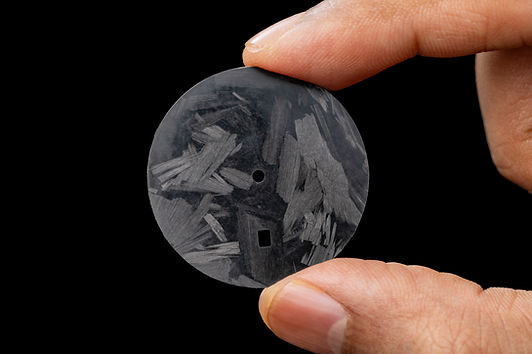
When recovered carbon becomes design
The Peninsula Carbon is more than a limited-edition mechanical watch.
It is a demonstration of what recovered materials can become when material science, engineering, and design come together.
Developed in collaboration with Bangalore Watch Company, the watch features a dial made using ReforgeCarbon™, a proprietary material created by combining forged carbon fibre with recovered carbon black (rCB). CarbonCraft contributed the recovered carbon black used in this material, extending our work in carbon utilisation beyond architecture and into precision product design.
Every dial develops its own pattern during manufacturing.
No two watches are identical.
The material itself becomes part of the story.
For us, this collaboration is not about entering the watch industry. It is about showing that recovered materials are not limited by the sectors they traditionally belong to. They can move across industries while retaining both performance and purpose.

The carbon we rarely talk about
Air pollution is often linked to vehicle exhaust, industrial smokestacks, and fossil fuels.
Far less attention is given to what happens after waste is processed.
India generates nearly 100 million end-of-life tyres every year, making tyre waste one of the country's largest industrial waste streams. Through pyrolysis, these tyres are broken down into oil, steel, gas, and a fine carbon powder known as recovered carbon black.
Pyrolysis solves one problem. It creates another.
Every year, an estimated 1.5 lakh tonnes of recovered carbon black is generated in India. Historically, much of it has had few high-value applications and has often been burned as a low-cost fuel in cement and brick kilns, returning carbon back into the atmosphere instead of keeping it in productive use.
The challenge is no longer collecting carbon.
It is finding meaningful ways to utilise it.
That question has guided CarbonCraft since the beginning.
Beyond the built environment
The building and construction industry is responsible for around 37% of global energy and process-related CO₂ emissions, while also consuming enormous volumes of raw materials every year. It presented an opportunity to replace a small portion of virgin resources with recovered ones at scale.
That thinking led to CarbonCraft's low-carbon material systems, where industrial byproducts are transformed into architectural products that combine performance, craftsmanship, and material innovation.
The Peninsula Carbon takes the same philosophy into a completely different context. The product changes. The material does not.
By demonstrating that recovered carbon can perform in a precision mechanical watch, the collaboration expands the possibilities for where recovered materials can create value.
It challenges the assumption that waste belongs only in waste management.
Instead, it belongs in design.

Changing how we value materials
One of the biggest barriers to circular manufacturing is not technology. It is perception.
Recovered materials are often seen as secondary alternatives, valued more for their environmental benefits than for their quality or performance.
Design has the ability to change that.
When a recovered material becomes part of a carefully engineered product, people stop seeing it as waste. They begin appreciating its texture, its character, and the story behind it.
Sustainability becomes something people can experience. Not just measure.
That shift matters because circular systems only work when recovered materials are genuinely desirable, not simply environmentally responsible.

The future of recovered materials
Every material has a first life. Very few are designed with a second one in mind.
As industries move toward lower-carbon manufacturing, the conversation cannot end with recycling or recovery. Those are only the beginning. What matters is whether recovered materials continue to circulate through products people value, use, and keep.
That is where design plays its biggest role.
Not simply making products look better.
But giving materials a future beyond waste.
