top of page


18 April 2026
Are Eco-Friendly Products One-Size-Fits-All?
Why urban homes need different eco-friendly products than rural ones?
Eco-friendly products are often presented as universal solutions. A better material. A smarter device. A more efficient system.
The assumption is that these solutions can be applied uniformly, regardless of where and how people live. But homes are not uniform.
An apartment in a dense urban setting and a house in a rural landscape function under very different conditions.
Climate, infrastructure, income, and access shape everyday decisions long before sustainability becomes a conscious choice.
This shifts the question. It is not about identifying the most sustainable product in isolation. It is about understanding whether a product
is appropriate for the context in which it is used.
Density changes everything
Urban homes are compact. Land is expensive, space is limited, and buildings are stacked vertically. This density increases efficiency in some ways.
Shared walls reduce heat loss. Public transport reduces travel emissions. But it also concentrates consumption.
Cities account for nearly 70% of global CO₂ emissions, despite covering less than 3% of the Earth’s surface. A large part of this comes from buildings
and the systems that support them.Apartments depend on elevators, water pumps, artificial lighting, and air conditioning. Ventilation is often mechanical
rather than natural. Windows are sealed to keep out pollution and noise. Eco-friendly products in urban homes therefore focus on reducing this load.
Energy-efficient appliances.
Low-flow fixtures.
Smart systems that monitor and optimize consumption.
They do not eliminate resource use.
They try to make it less intensive.
When infrastructure is already doing the work
Urban sustainability is closely tied to centralized infrastructure systems. Water is supplied through pipelines, waste is externally managed, and electricity
is largely continuous, even if not always derived from clean sources. This enables the adoption of certain eco-friendly products. A water-efficient fixture is
effective because supply is reliable. An energy-efficient appliance performs consistently because electricity is available. At the same time, this system creates
a degree of separation. Consumption becomes less visible. Waste is removed from the immediate environment. Energy use is reduced to periodic billing
rather than daily awareness.
In this context, many urban eco-friendly products are designed to respond to this distance. They measure, monitor, and optimize resource use within
systems that users do not directly engage with.

Rural homes and low-consumption systems
In rural contexts, the baseline conditions are fundamentally different.
Homes typically occupy larger footprints but exist within lower densities. They rely more on passive strategies such as natural ventilation, daylight,
and open spatial layouts. Resource use is often lower, not as a deliberate sustainability choice, but as a response to availability and cost.
This is reflected at a global scale. The bottom 50 percent of the population accounts for approximately 12 percent of total emissions, while the
top 10 percent contributes close to 48 percent. Lower consumption is not marginal. It is the prevailing condition for a significant portion of the world.
These differences reshape what constitutes an eco-friendly solution.
High-efficiency appliances may have limited relevance where electricity supply is inconsistent. Advanced water systems offer less value where access
to water itself is uncertain. Instead, the focus shifts toward addressing fundamental gaps.
Clean cooking solutions that reduce indoor air pollution.
Rainwater harvesting systems in areas without reliable piped supply.
Decentralized solar lighting where grid stability is an issue.
The objective is not optimization within an existing system.
It is ensuring access, reliability, and basic performance.
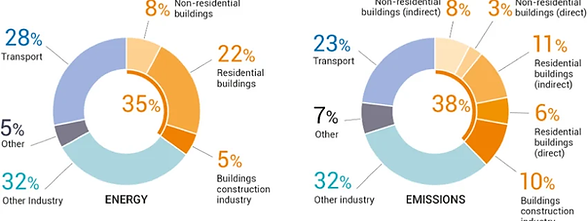
Image Credits: Global share of buildings and construction final energy and emissions, 2019 (UNEP 2020)
Materials tell a different story
Urban construction depends heavily on industrial materials. Concrete, steel, and glass dominate the built environment. These materials are
durable and standardized. They are also carbon-intensive. The building sector alone accounts for around 30% of global final energy consumption and
26% of energy-related emissions.
A significant portion comes from material production.
Eco-friendly alternatives in cities try to reduce this impact.
Recycled content.
Low-carbon manufacturing.
Prefabrication to reduce waste.
In rural areas, material choices often come from what is locally available. Earth, stone, bamboo, timber. These materials typically
have lower embodied energy and require less transportation. But they come with other challenges.
Durability.
Maintenance.
Perception of value.
The issue is not always reducing carbon.
Sometimes it is improving performance without losing the environmental advantage.
At CarbonCraft, the focus is on rethinking materials at their source. Not as finishes, but as systems of impact.
Products such as the DEEWAAR tile series combine upcycling, design, and craftsmanship to transform industrial byproducts into high-performance
, carbon-negative materials.
Composed of at least 96% industrial waste, each square foot repurposes approximately 1.9 kg, converting emissions into tangible architectural surfaces.
By repurposing industrial waste, each square foot diverts a measurable amount of waste from landfills while reducing embodied carbon and dependence
on virgin resources.
The approach combines design, technology, and craftsmanship to create scalable materials that can integrate into contemporary construction practices.
It also reflects a broader shift in how materials are viewed, not as linear resources to be used and discarded, but as part of a continuous cycle that addresses
climate impact, material scarcity, and livelihoods within the construction ecosystem.

One solution does not scale everywhere
Many eco-friendly products are designed with urban users in mind. They assume stable infrastructure, disposable income, and easy access to maintenance.
That already narrows where they can work.
Outside cities, the same products don’t always fit. Not because they are ineffective, but because the conditions are different.
At the same time, many rural practices don’t make their way into mainstream products. Even when they work well. Even when they are more climate-
responsive.
Why? Because they are often informal. Built around local knowledge. Adapted to specific climates and materials. They are not always standardized,
not always documented, and rarely designed for mass production.
Markets struggle with that. So do supply chains. It is easier to scale a product than a practice.
There is a gap here.
Not of innovation, but of translation.
Rethinking what “eco-friendly” means
If sustainability is defined only through high-performance products, it becomes a narrow metric. One that prioritizes efficiency within systems, but often
ignores whether those systems were necessary to begin with.
A naturally ventilated house that avoids air conditioning altogether can have a significantly lower operational footprint than one that relies on even the
most efficient AC systems. Yet, it rarely enters the conversation, because it is not a product. It is a design decision.
Similarly, durability and repairability often outperform recyclability in real terms. Extending the life of a material delays replacement, reduces demand for
new resources, and cuts down cumulative emissions over time. But these benefits are harder to quantify, and harder to market.
This is where context becomes critical.
In urban environments, sustainability often operates within already resource-intensive systems. The role of eco-friendly products here is to reduce excess,
improve efficiency, and lower the impact of what cannot be eliminated.
In rural settings, the priorities shift. Limited infrastructure, variable access, and direct climate exposure mean that resilience, adaptability, and material
appropriateness become more important than optimization.
Both approaches address environmental impact.
But they do so from different starting points.
Toward contextual sustainability
The built environment accounts for a significant share of global emissions, and with increasing urbanization, the demand for materials, energy, and i
nfrastructure will continue to rise.
However, scaling sustainability cannot rely on applying uniform solutions across diverse contexts.
It requires designing for difference.
Understanding patterns of living.
Recognizing varying levels of access to infrastructure and resources.
Responding to actual needs rather than assumed ones.
A product or system is only sustainable when it performs effectively within the conditions it is placed in.
Not in theory.
But in practice.
https://www.nature.com/articles/s42949-023-00084-2

bottom of page